'/%3e%3cpath%20id='Vector_2'%20fill-rule='evenodd'%20clip-rule='evenodd'%20d='M41.7365%206.2391C40.7304%206.2391%2039.915%207.05458%2039.915%208.06058C39.915%209.06663%2040.7304%209.88206%2041.7365%209.88206C42.7423%209.88206%2043.558%209.06663%2043.558%208.06058C43.558%207.05458%2042.7423%206.2391%2041.7365%206.2391Z'%20fill='var(--fill-0,%20white)'/%3e%3cpath%20id='Vector_3'%20fill-rule='evenodd'%20clip-rule='evenodd'%20d='M11.2236%206.56889C11.2236%206.74741%2011.076%206.89236%2010.8943%206.89236H2.52113V2.50723H10.8943C11.076%202.50723%2011.2236%202.65189%2011.2236%202.8307V6.56889ZM9.43021%200.0836868H0V13.999H2.52113V9.31585H9.42997C11.7867%209.31585%2013.6975%207.43888%2013.6985%205.12302L13.699%204.27991C13.7%201.96262%2011.7886%200.0836868%209.43021%200.0836868Z'%20fill='var(--fill-0,%20white)'/%3e%3cpath%20id='Vector_4'%20fill-rule='evenodd'%20clip-rule='evenodd'%20d='M63.789%2011.3469C63.789%2011.5257%2063.644%2011.6704%2063.4652%2011.6704H55.7529C55.5744%2011.6704%2055.4294%2011.5257%2055.4294%2011.3469V0.0836868H53.0144V9.80446C53.0144%2012.1211%2054.8923%2013.999%2057.2088%2013.999H62.0102C64.3268%2013.999%2066.2048%2012.1211%2066.2048%209.80446V0.0836868H63.789V11.3469Z'%20fill='var(--fill-0,%20white)'/%3e%3cpath%20id='Vector_5'%20fill-rule='evenodd'%20clip-rule='evenodd'%20d='M19.8448%2011.2329V0.0655822H17.324V10.3478C17.324%2012.3539%2018.9897%2013.9799%2021.0438%2013.9799H29.5237L30.3019%2011.5564H20.176C19.9931%2011.5564%2019.8448%2011.4117%2019.8448%2011.2329Z'%20fill='var(--fill-0,%20white)'/%3e%3cpath%20id='Vector_6'%20fill-rule='evenodd'%20clip-rule='evenodd'%20d='M81.0406%2011.253C81.0406%2011.4316%2080.8957%2011.5765%2080.7171%2011.5765L72.727%2011.5748V2.50822H80.7171C80.8957%202.50822%2081.0406%202.65288%2081.0406%202.83169V11.253ZM79.279%200.0846748H70.2495V14H79.2776C81.5936%2014%2083.4716%2012.1227%2083.4721%209.80665L83.4735%204.28044C83.4742%201.96337%2081.5961%200.0846748%2079.279%200.0846748Z'%20fill='var(--fill-0,%20white)'/%3e%3c/g%3e%3c/svg%3e)
August 7, 2026 • Product • 5 min read
Why AI Products Building Voice Capture Should Integrate with Wearable Devices
By building dedicated wearable devices for recording conversations, we've been able to solve many of the hardest challenges for capturing in-person conversations. With Plaud Embedded, we want to share that hardware with you.
 Jack
JackIf you’re building an AI product that captures conversation data, you know that capturing voice data has its own set of challenges. From clunky user experiences to inconsistent recording quality, recording conversations with mobile apps or web apps alone can be lacking for users in different working environments.
Plaud Embedded is an SDK & API to integrate your AI application with Plaud’s wearable devices and transcription services to capture and turn your users' conversations into AI-ready context. Plaud Embedded solves many of the most challenging issues for capturing clean speech data, so your AI product can draw insights and work with the highest quality data.
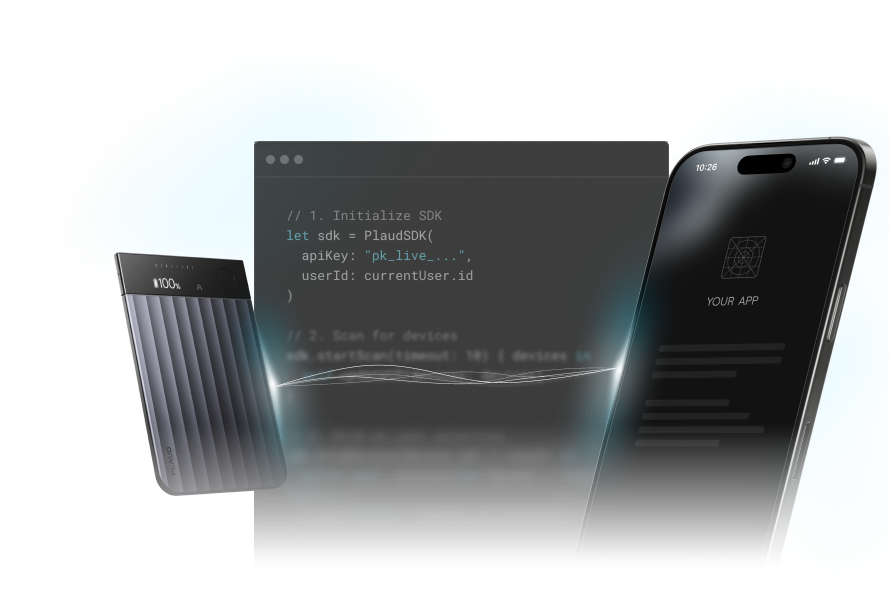
Why build with Plaud
At Plaud, we built the #1 AI note takers in the market, and a key differentiator for us has been our purpose-built wearables. While other solutions capture audio over smartphone and desktop apps, they couldn’t provide a consistently seamless experience. Smartphones and laptops:
- Were not designed to record audio in different conditions - noisy environments, multi-speaker meetings, or speakers at faraway distances
- Do not support hands-free workflows, especially where users are moving around during the conversation
- Lead to awkward users experiences where users need to pull out their phones or desktop app to capture in-person conversations
- Have offline limitations in work environments like construction sites or remote locations

By building our own wearable devices, we’ve solved these challenges, and found ourselves better equipped to build more accurate transcription and diarization (speaker labeling) by coupling our transcription pipeline with our hardware’s on-device algorithms.
With Plaud Embedded, we’ve opened up our end-to-end hardware and speech-to-text pipeline so you can offer your users:
- A seamless product experience
- Consistent recording quality and data capture
- Best-in-class transcription and diarization models
User Experience for Recording
Desktop meeting recorders like Zoom and Google Meet have a great experience because of their ease-of-use. Jump into an online meeting, and your recorder is there.
When your users are doctors, plumbers, retail associates or anyone that operates primarily in-person, recording should be just as seamless as well. That’s where Plaud devices come in. Just one press starts a recording.
Plaud devices have their own battery and storage, packaged in sleek design forms. With the Note Pro, you can place it on the back of your phone or any surface. With the NotePin S device, your users can wear their recording device on their lapel, wrist, or coat.
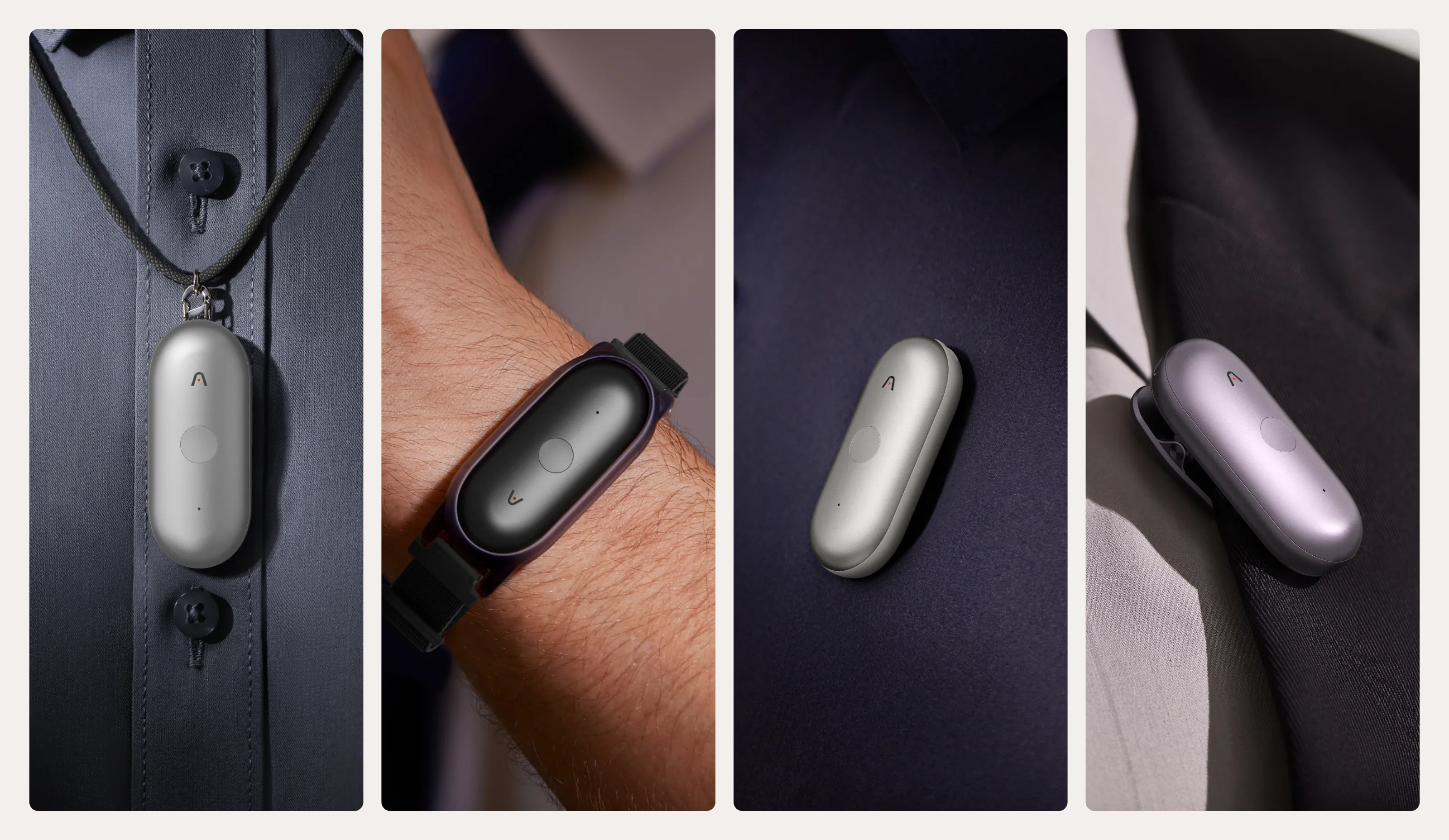
Recording on a Plaud device might not sound that different from recording on a smartphone, but we’ve talked with many customers (see some of our customer stories) who have driven significantly more product usage and captured much more complete context when their users are given a wearable device.
When your users need multiple swipes and taps to first open a recording app and then to hold the phone during the conversation, that’s friction.
When your users have to drain their phone batteries on conversation-heavy days, that’s friction.
When your users may have to record with spotty connections, but can’t record without internet connection, that’s friction.
All these friction points add up to subpar product experiences and lower usage. If users are inconsistent with recording their conversations, your AI product is leaving context on the table and won’t be able to provide maximum value for users.
Consistent Recording Quality
Many Plaud Embedded customers integrated with Plaud’s SDK because even if the user experience constraints were bearable, their users wanted a dedicated recording device that fit with their daily workflow.
Plaud devices like the NotePin S and Note Pro ensure that your users have best-in-class recording devices, purpose-built for different recording environments:
- Conversations in noisy environments
- Multi-speaker conversations
- Conversations where speakers maybe standing at farther distances
- Conversations in areas without internet connection
- Phone conversations
Plaud devices are built with a multi-microphone design that can capture audio from longer distances, in different directions. These microphones encode directional data about where audio is coming from and can capture speech audio in the different recording environments your users may take your product.
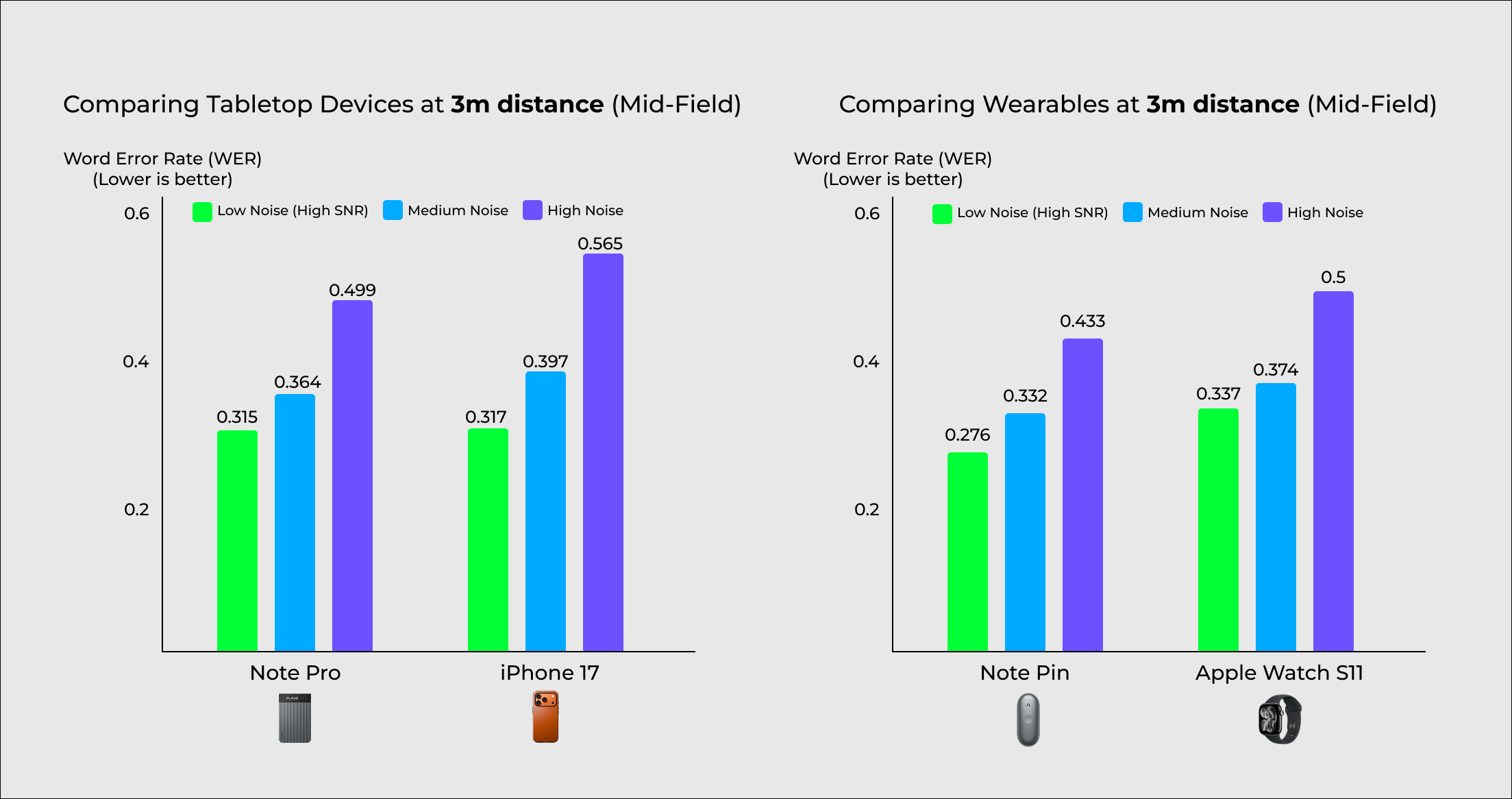
We frequently benchmark our devices against devices like the iPhone 17 and the Apple Watch S11. We’ve gone so far as to build variable-controlled chambers like this one to measure device performance.
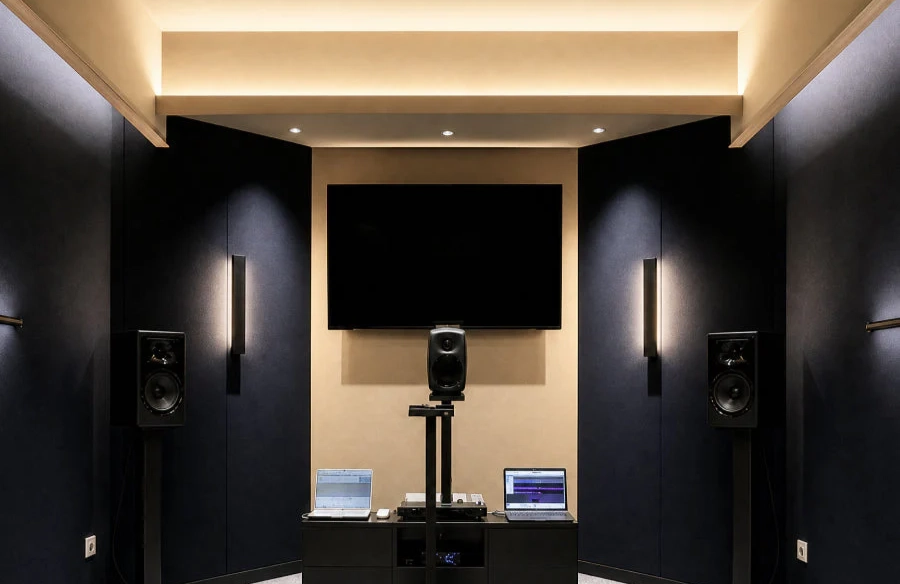
From our latest experiments, we measured Word Error Rate (WER). Plaud devices outperform Apple devices at every noise level, but especially in noisy environments with varying signal-to-noise ratios (SNR).
Read the full writeup in our anechoic chamber experiments.
Best Transcription & Diarization for Offline Environments
A big feature of owning our wearable hardware is that we have designed our speech-to-text (STT) and diarization pipeline specifically tailored to our device specs. This tight coupling allows our Transcription API to deliver better accuracy than other services that operate on software alone.
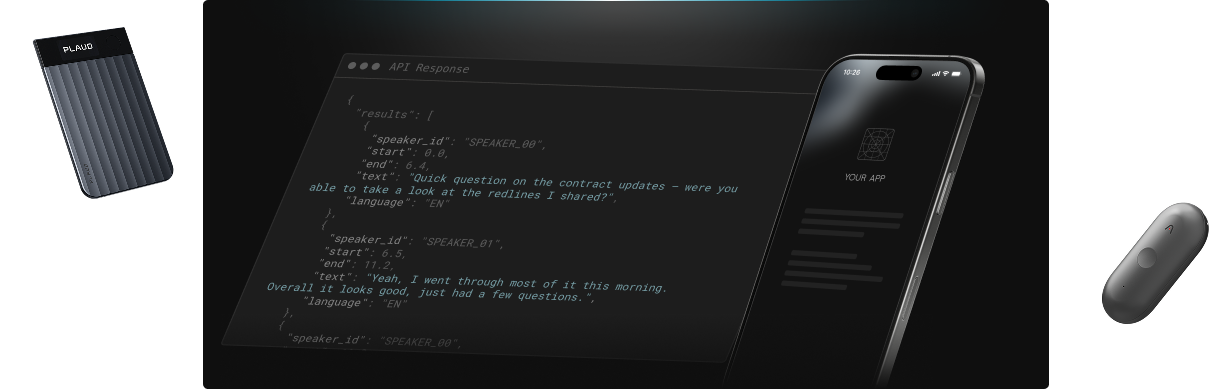
The multi-microphone design on Plaud devices enable on-device algorithms for spatial filtering (beamforming), voice position estimation, and noise suppression. This is what allows Plaud to accurately diarize and assign speaker labels in different conversation environments.
Integrating with Plaud via Plaud Embedded isn’t just an integration with Plaud’s wearable hardware, it’s also an integration with Plaud’s algorithms and STT pipeline. Trained on offline conversation data and experiments we run when building the Plaud app we offer to consumers, Plaud’s STT & diarization pipeline is available to Plaud Embedded users.
Conclusion
If capturing voice data is a key part of your AI application, capture that voice data with the best hardware and transcription. Your users get the best recording experience. Your product gets the best audio and transcription data.
Sign up for the Plaud Developer Platform and get started with Plaud Embedded completely free (no credit card required). Visit the Plaud Embedded docs for more technical details on how it works.