'/%3e%3cpath%20id='Vector_2'%20fill-rule='evenodd'%20clip-rule='evenodd'%20d='M41.7365%206.2391C40.7304%206.2391%2039.915%207.05458%2039.915%208.06058C39.915%209.06663%2040.7304%209.88206%2041.7365%209.88206C42.7423%209.88206%2043.558%209.06663%2043.558%208.06058C43.558%207.05458%2042.7423%206.2391%2041.7365%206.2391Z'%20fill='var(--fill-0,%20white)'/%3e%3cpath%20id='Vector_3'%20fill-rule='evenodd'%20clip-rule='evenodd'%20d='M11.2236%206.56889C11.2236%206.74741%2011.076%206.89236%2010.8943%206.89236H2.52113V2.50723H10.8943C11.076%202.50723%2011.2236%202.65189%2011.2236%202.8307V6.56889ZM9.43021%200.0836868H0V13.999H2.52113V9.31585H9.42997C11.7867%209.31585%2013.6975%207.43888%2013.6985%205.12302L13.699%204.27991C13.7%201.96262%2011.7886%200.0836868%209.43021%200.0836868Z'%20fill='var(--fill-0,%20white)'/%3e%3cpath%20id='Vector_4'%20fill-rule='evenodd'%20clip-rule='evenodd'%20d='M63.789%2011.3469C63.789%2011.5257%2063.644%2011.6704%2063.4652%2011.6704H55.7529C55.5744%2011.6704%2055.4294%2011.5257%2055.4294%2011.3469V0.0836868H53.0144V9.80446C53.0144%2012.1211%2054.8923%2013.999%2057.2088%2013.999H62.0102C64.3268%2013.999%2066.2048%2012.1211%2066.2048%209.80446V0.0836868H63.789V11.3469Z'%20fill='var(--fill-0,%20white)'/%3e%3cpath%20id='Vector_5'%20fill-rule='evenodd'%20clip-rule='evenodd'%20d='M19.8448%2011.2329V0.0655822H17.324V10.3478C17.324%2012.3539%2018.9897%2013.9799%2021.0438%2013.9799H29.5237L30.3019%2011.5564H20.176C19.9931%2011.5564%2019.8448%2011.4117%2019.8448%2011.2329Z'%20fill='var(--fill-0,%20white)'/%3e%3cpath%20id='Vector_6'%20fill-rule='evenodd'%20clip-rule='evenodd'%20d='M81.0406%2011.253C81.0406%2011.4316%2080.8957%2011.5765%2080.7171%2011.5765L72.727%2011.5748V2.50822H80.7171C80.8957%202.50822%2081.0406%202.65288%2081.0406%202.83169V11.253ZM79.279%200.0846748H70.2495V14H79.2776C81.5936%2014%2083.4716%2012.1227%2083.4721%209.80665L83.4735%204.28044C83.4742%201.96337%2081.5961%200.0846748%2079.279%200.0846748Z'%20fill='var(--fill-0,%20white)'/%3e%3c/g%3e%3c/svg%3e)
How FrontlineIQ brings AI coaching to retail sales
Interview with

Ben Rodier
CEO & Founder of FrontlineIQ
About FrontlineIQ
Millions of people sell face to face in stores, branches, showrooms, and dealerships every day. But while technology has transformed how companies sell online, in-person sales teams have been left with far fewer tools to improve how they sell.
FrontlineIQ is an AI sales coach built for those teams. It identifies the behaviors most likely to improve a rep’s performance, then helps reps practice those behaviors until they stick. Managers get the same intelligence in reverse, showing them who needs coaching, what to coach, and where to focus first.
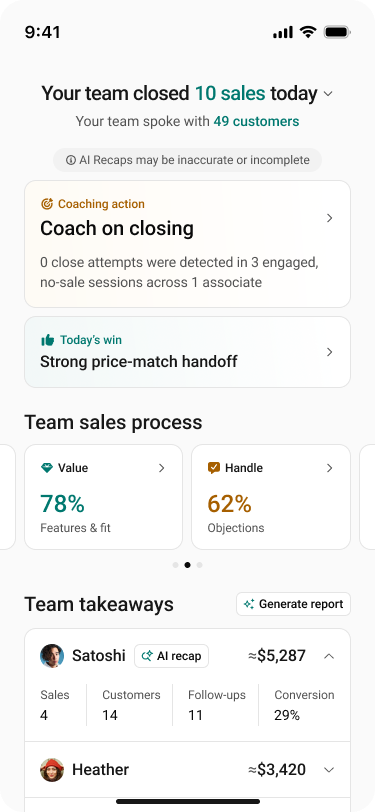
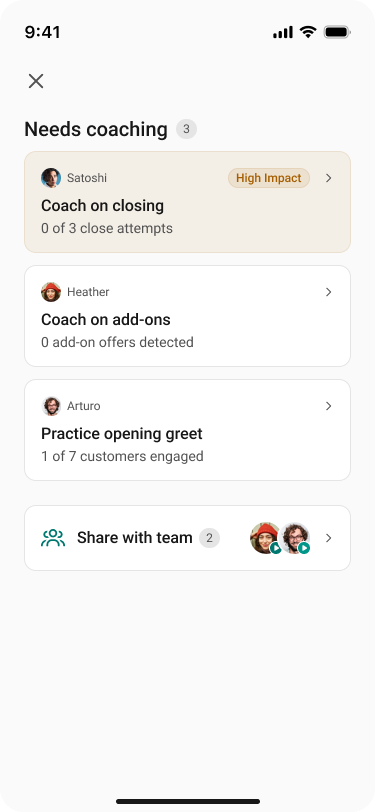
FrontlineIQ’s coaching was built on training and role-play. What it couldn’t do was hear the live, unscripted conversations on the sales floor, where those skills actually played out.
The Problem
Managers can’t be everywhere at once. On a busy floor a manager is running recruiting, feedback, and performance at once, and can only be in one place at a time. As Ben Rodier, FrontlineIQ’s CEO and founder, put it: “When you have ten people on your sales floor all talking to customers, day in and day out, you can’t be in all those conversations at once.”
What slips away with them is the coaching signal. A rep may improve on one behavior while slipping on another, and a manager rarely catches the change as it happens. “What’s lost is all of the intelligence and all of the information we get from those conversations,” Ben said.
And the signal isn’t just in the words. It’s in the pace, the tone, the interruptions, and the moment a rep talks over a customer. To coach those behaviors, FrontlineIQ needs to hear the conversation as it actually happened.
The Search
The obvious place to start was the phone already in every rep’s pocket.
The plan was simple on paper: record the best salespeople on a phone and share what they did well across the team. But when Ben pitched it to a top seller, he got a one-line answer:
“Absolutely not. There’s the door,” he recalled.
The problem wasn’t recording. It was asking a salesperson to think about recording while they were selling. Customers walk in unannounced, often while a rep is mid-conversation with someone else. Catching that moment on a phone means stopping to pull it out and hit record, right when a rep can least afford the distraction. “The ability to start and stop is a huge piece of friction,” Ben said. On a live sales floor, that friction is enough to kill the idea entirely.
What FrontlineIQ needed was a purpose-built device: something a rep could wear and forget, and that a customer could see and accept, capturing the conversation without anyone having to manage it.
Why Plaud Embedded
Plaud Embedded fit because it gave FrontlineIQ something the phone couldn’t: a purpose-built capture device that could become part of the sales experience rather than interrupt it.
A rep wears the NotePin S on the sales floor. There’s no phone to pull out and no moment to manage. The conversation just happens, and it’s captured.
The recordings then flow into FrontlineIQ through Plaud Embedded’s SDK and transcription pipeline, giving its coaching system the conversations it needs without creating a cumbersome workflow for the rep.
The device also has to last the whole shift. If the battery dies partway through, so does the capture. “A battery running out in the middle of the shift is simply not an option,” Ben said.
Capturing the conversation isn’t enough on its own. FrontlineIQ needs to understand how a rep sells, not just whether the sale closed. “Tone and intonation is often just as important as what is actually being said,” Ben said. A full recording preserves the pace and interruptions that a transcript flattens into text, so FrontlineIQ can hear how the rep actually sold.
The Outcome
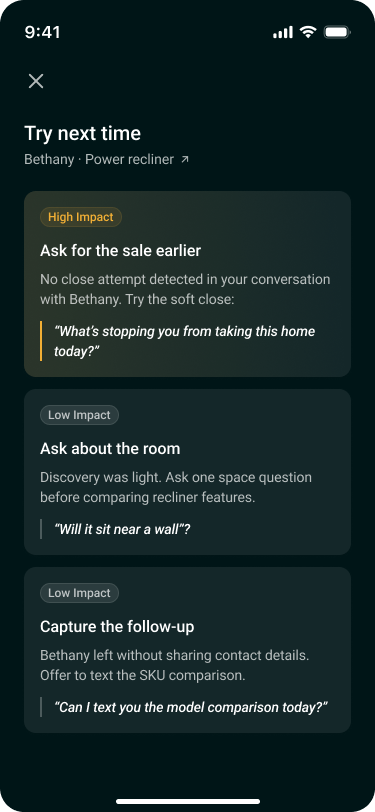
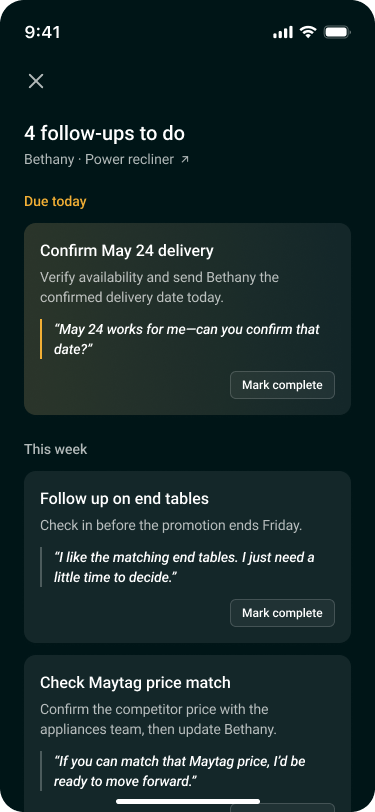
The coaching now starts from the conversation that actually happened. At the end of a shift, a rep can see how many customers they served, which ones bought, the follow-ups they promised, and the products they talked through. Managers can work from the same record instead of from memory.
FrontlineIQ has also seen a measurable relationship between sustained coaching and sales performance.
“Once you’ve reached 30 AI coaching sessions, we start to see salespeople sell $2,900 more on a weekly basis per user, averaged across the business,” Ben said, comparing reps who lean into the coaching against those who don’t.
The floor conversation is what feeds that coaching: the more of the real interaction FrontlineIQ can see, the more precisely it can tell a rep what to work on.
What's Next
But the value of those conversations doesn’t stop with the rep or their manager. The same conversations contain market intelligence and insights that could be valuable to the brands whose products are being sold.
Take, for example, a customer whose fridge just failed and flooded the kitchen. A good rep guides them from frustration to the right replacement, and somewhere in that conversation is a detail the manufacturer would want: the ice maker had failed twice in the months before it gave out. “That’s information that should go to the service team or the warranty team,” Ben said.
For Ben, that’s the larger opportunity: connect what happens in training with what actually happens on the sales floor, and make the intelligence in those conversations available to everyone who can use it.
FrontlineIQ is building on Plaud Embedded, the platform for developers to integrate with Plaud’s devices, mobile SDK, and transcription infrastructure built for real-world conversations.